A Structured Journaling System
14-Day GuaranteeJournaling made your anxiety worse.
Structure is the fix.
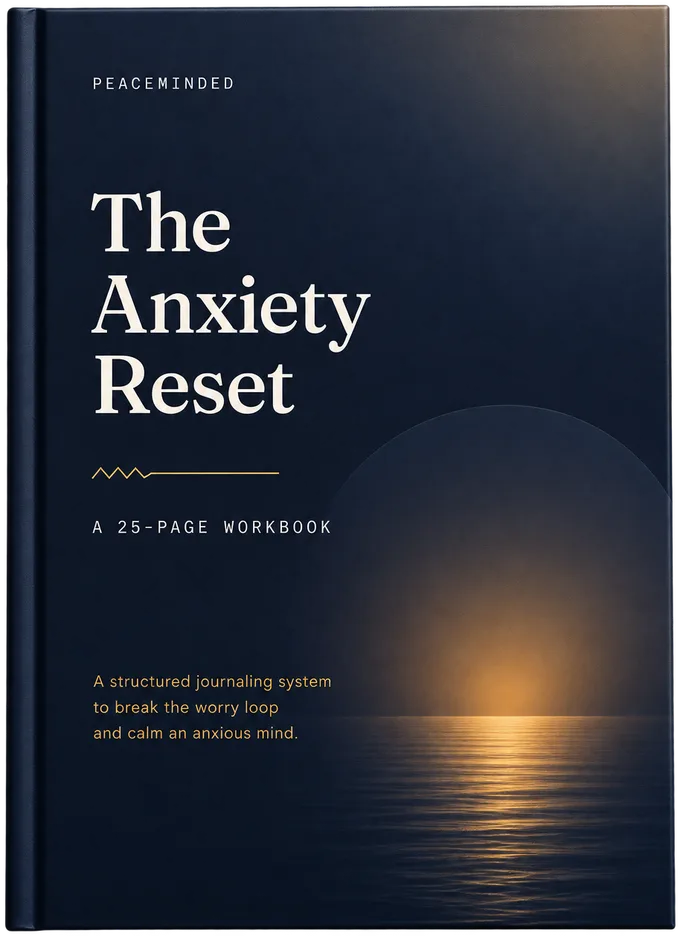
Open a blank journal with an anxious brain and it doesn’t unwind—it loops. The Anxiety Reset is a 25-page workbook built on the Discharge → Examine → Reframe method, with a 30-day plan. Every prompt has a specific job to do.
No app. / No subscription./ Just this guide and a pen.
Why Journaling Backfires
Most journaling advice assumes
your brain is ready to reflect.
When you open a blank page and write whatever comes to mind, an anxious brain doesn’t unwind—it loops. Ten minutes later you’ve produced two pages of text and feel measurably worse. That’s not journaling. That’s rumination with a pen.
Rumination
- Returns to the same fear from multiple angles without resolving any of them.
- Asks “why is this happening to me?” without expecting a useful answer.
- Amplifies urgency the longer it continues.
Structured Writing
- Names the fear precisely, then moves on to examining it.
- Asks questions that have answerable answers.
- Produces a slight release of tension—not because the problem is solved, but because your nervous system was given somewhere to go.
If you finish writing and feel tighter than when you started, you were probably ruminating. The Anxiety Reset is designed to interrupt that cycle before it compounds.
This Is For You If
- Your mind races before bed, or loops through the same worry on repeat.
- You’ve tried generic journaling (“just write what you feel”) and finished feeling worse, not better.
- You want a structured, repeatable method—not vague prompts—that you can return to whenever anxiety spikes.
It Is Not A Substitute For
- Clinical care. If anxiety is significantly disrupting your sleep, work, or relationships, this guide works best alongside a therapist or doctor—not instead of one.
- Crisis support. If you’re in crisis right now, these lines are staffed 24/7.
The Method
Discharge → Examine → Reframe
Every prompt in the guide operates within this three-phase structure— whether you’re using it for a five-minute check-in or a full entry.
Discharge
Getting the noise out.
Get the raw anxiety out of your head and onto the page, unfiltered. This phase is deliberately unstructured. It exists to empty the tank, not to produce insight.
Examine
Understanding what is actually happening.
Slow down and look at what you just wrote. Identify the core fear underneath the surface worry, separate fact from assumption, and locate where you actually have influence.
Reframe
Writing toward calm.
Not toxic positivity. Building a more accurate and workable version of the situation—one your nervous system can actually act on.
Why This Works
Built on research, not a personal story.
We’re not going to tell you this guide came out of a personal battle with anxiety—it didn’t. What it’s built on is a well-documented pattern in how anxious minds handle unfinished thoughts.
Unfinished or unresolved tasks tend to stay more “active” in memory than tasks you’ve closed out—part of why an open worry can feel like it keeps demanding attention. This is known in psychology as the Zeigarnik effect, first documented in 1927.
Worth noting honestly: later research has found this effect isn’t perfectly consistent across everyone or every situation—but the related, more consistently observed pattern is that people feel a strong pull to return to unfinished things. Giving a worry a fixed, finished place on the page is a simple way to work with that pull instead of against it.
This guide is a self-guided tool, not a clinical treatment, and it makes no claim to cure or eliminate anxiety. It’s a structure for working with it—built to be honest about what it can and can’t do.
What’s Inside
Everything you need. Nothing you don’t.
25-Page PDF Workbook
The full DER method, explained phase by phase, ready to use on any device or printed.
30-Day Guided Plan
A four-week ramp—from Discharge-only to full independent practice—so the habit builds without burnout.
Printable Worksheets
Guided prompts for morning anxiety, night-before worry, catastrophic thinking, social and health anxiety.
Pattern & Physical Cue Log
A simple system for tracking recurring triggers and early body signals over time.
30-Day Tracker
A visual tracker to mark practice—not for a perfect streak, but for showing up.
Crisis Resources
Hotlines for the US, UK, and Australia, plus guidance for finding support anywhere else.
A Few Common Questions
FAQ
Is this a subscription?
No. It’s a one-time payment of $12 for the PDF. No account, no recurring charge, nothing to cancel.
How do I receive it?
Gumroad emails you the PDF instantly after checkout, and you can also re-download it from your Gumroad library any time.
Do I need to print it?
No. The worksheets work either way. Print them and write by hand, or fill them in digitally on a tablet or PDF app.
Is this a substitute for therapy?
No, and it doesn’t claim to be. It’s a self-guided journaling structure, not a clinical treatment. See our note on where it fits and where it doesn’t.
What if the structure doesn’t work for me?
Work through the first week. If it doesn’t fit how your mind works, email us within 14 days and we’ll refund it — no questions asked.
Not Ready To Buy?
Try the first exercise, free.
Get the actual Discharge exercise from the workbook, the ten-minute timed writing practice, as a free 2-page PDF. No pressure, just the real thing.
Get the Free SampleNot sure yet? Take the 30-second quiz
14-Day Guarantee
Try it for two weeks.
Work through the first week of the plan. If the structure doesn’t fit how your mind works, email us within 14 days and we’ll refund it—no questions, no form to fill in.
Get the Workbook — $12 USDSold on Gumroad · instant PDF · one-time payment
Anxiety does not disappear because you decide to feel better.
It shifts when you interrupt the patterns that keep it running.
One Important Boundary
This guide is a structured self-reflection tool. It is not a substitute for clinical care.
It does not diagnose, treat, or cure anxiety, and it makes no claim to. If your anxiety is significantly disrupting your daily functioning, your sleep, your relationships, or your work, please speak with a qualified mental health professional. Consider reaching out if anxiety is intensifying rather than fluctuating, if intrusive thoughts, panic attacks, or physical symptoms are worsening, or if writing helps you describe a problem but not reduce how much it weighs on you.
If You Need Support Right Now
These lines are staffed 24/7 by people trained for exactly this moment.
- United States
- Call or text 988 (988 Suicide & Crisis Lifeline), 24/7, or chat at 988lifeline.org
- United Kingdom
- Call Samaritans free on 116 123, 24/7
- Australia
- Call Lifeline on 13 11 14, or Beyond Blue on 1300 22 4636, 24/7
- Elsewhere
- Search "crisis helpline" plus your country name, or go to your nearest emergency department